Buying guide
Do Pitcher Filters Remove Microplastics?
Buy a compatible Brita 10-cup pitcher with the Elite OB06 filter if you want the clearest pitcher claim for microplastics at the lower upkeep cost in this comparison. The blue Elite cartridge matters; a Brita Standard cartridge is not the same filter.
PureWater Filter Finder Research · Updated · 15 min read
We may earn from qualifying purchases. Price ranges are budgets, not live offers. Choose the right model before comparing deals.
Buy Brita Elite for the clearest pitcher claim
Yes, a pitcher can reduce microplastics, but the claim belongs to an exact cartridge and system. Brita Elite OB06 has a certified result for one narrow particle band. Clearly Filtered publishes a larger laboratory percentage, but its current public table does not name the particle sizes, so the two numbers are not a fair head-to-head test.
Stop before buying if your water may contain germs, is under an advisory, or comes from an untested well. A microplastics claim does not make a pitcher a purifier. It also does not promise a health benefit. The FDA says current evidence does not show that detected levels in water pose a human-health risk and notes that test methods and size definitions still differ.
What earns a place in this guide
A pitcher must name the exact cartridge, give a microplastics result, state a service limit, fit treated tap water, and have a current replacement path. Certification for the named claim gets more weight than a maker-paid laboratory result. Missing evidence is not scored as zero, so this guide does not publish a numerical product score.
- Water source
Use these pitchers on suitable treated tap water. A private well needs a current safety test and treatment plan first.
- Measured problem
Match every other concern, such as lead or PFAS, to the same exact filter sheet. A microplastics claim proves only its stated job.
- Household demand
One gallon a day means at least two full 10-cup pitcher volumes. Two gallons means at least four, before spills or water left in the reservoir.
- Space and use
Both avoid plumbing and power. Check refrigerator clearance, lifting weight, filling time, and whether the pitcher will stay full.
- Upkeep and budget
Count the next cartridges, not only the starter kit. Use both the gallon limit and the time limit.
- Desired outcome
Choose a pitcher for drinking and cooking water. Pick another format when daily refilling will keep the household from using it.
How the evidence was weighed
The Water Quality Association explains that certification checks the product against a stated standard and keeps manufacturing under audit. That makes Brita's exact certified claim stronger for this buying decision than a test row without a published particle-size band.
Robert C. Andrews, PhD, PEng, is a University of Toronto professor whose work centers on drinking-water treatment and microplastics. He co-authored a Polymers study of three unnamed pour-through devices. The two devices with microfiltration removed more of the 30 to 1,000 micron test particles than the device using only granular carbon and ion exchange. The brands were not disclosed, and the particles were much larger than Brita's 0.5 to 1 micron certification band. The study supports checking the physical barrier and exact test, not transferring its results to either pitcher here.
Evidence limit We did not field-test either pitcher, measure flow, or count particles. The recommendation rests on current exact-model records, certifier scope, replacement limits, and disclosed household-use math.
The two pitchers are not equal on proof
| Decision | Brita Elite OB06 | Clearly Filtered CF-PRF |
|---|---|---|
| Microplastics evidence | WQA-certified NSF/ANSI 401 claim | Maker-published independent laboratory result |
| Published result | 99.6% for 0.5 to 1 micron particles | More than 99.99%; no size band shown in the public row |
| Rated life | 120 gallons or about six months | 100 gallons or six months |
| One gallon daily | Four cartridges from new per year | Four cartridges from new per year |
| Planning equipment range | $35 to $60 | $90 to $120 |
| Main reason to buy | Clear exact-model certification at lower cost | Broader maker-published testing for other water goals |
| Sale stopper | Kit includes Standard instead of Elite, or refilling is too frequent | You need a certified microplastics claim with a stated size band |
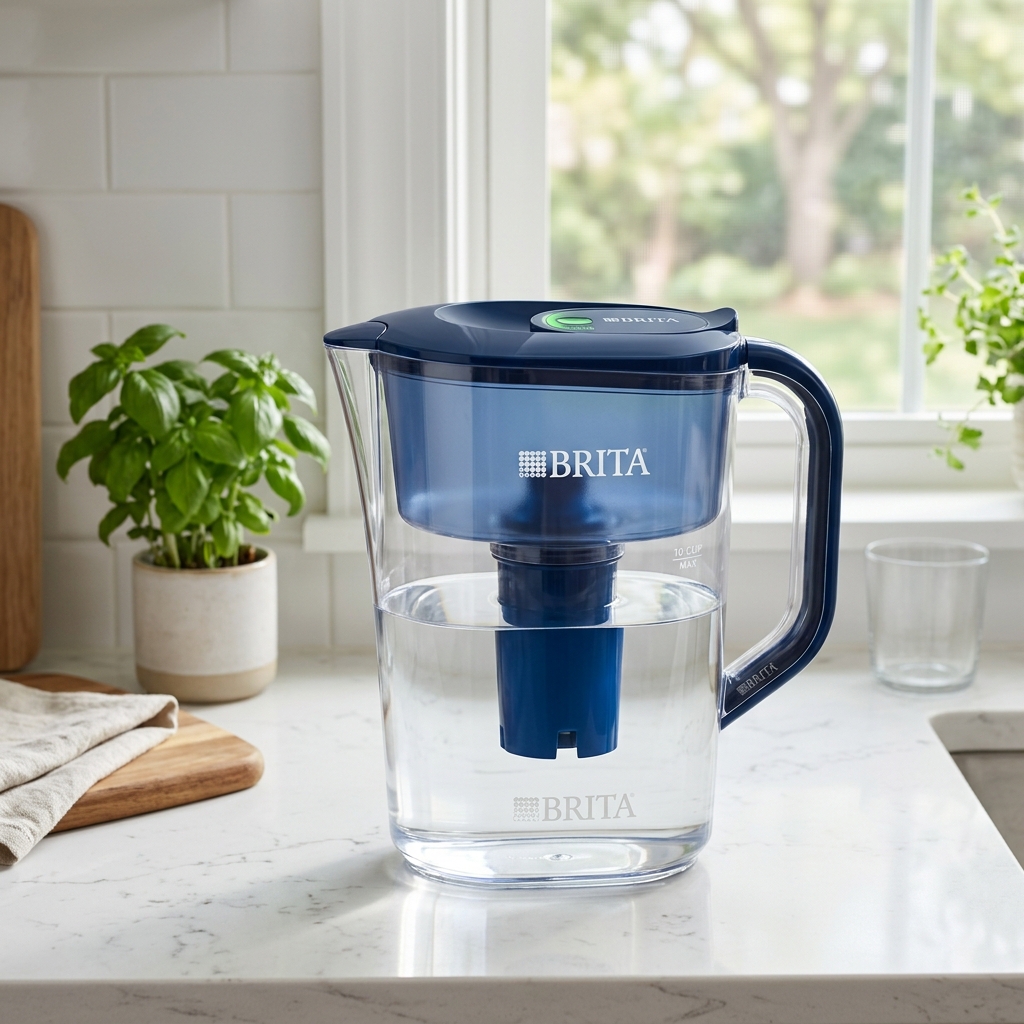
Brita 10-Cup Pitcher with Elite Filter
Typically $35–$60 · equipment only
Choose it if you use treated tap water, want a no-install pitcher, and can keep up with at least two full 10-cup volumes for each gallon used.
What supports the choice The Brita Elite OB06 performance sheet lists 99.6% microplastics reduction for 0.5 to 1 micron particles, more than 10,000 particles per milliliter in the challenge water, and WQA certification to NSF/ANSI 401 for the listed compatible systems. It sets a 120-gallon or roughly six-month replacement point and says to process no more than two gallons daily.
What costs the sale A household using two gallons daily will refill a 10-cup pitcher at least four times and plan seven cartridges from new over a year. Large bottles, cooking, or several users can make a dispenser or plumbed filter easier to keep using.
Before ordering Confirm the listing includes the blue Elite OB06 cartridge and a compatible pitcher model. Owners of a compatible pitcher can buy the correct Elite replacement instead of another pitcher. That replacement-only path is not monetized here.
Clearly Filtered needs one more detail for this job
The P-V3 remains a conditional option for buyers who value its broader maker-published contaminant report. It does not receive the microplastics recommendation here because the public test row leaves out the particle-size band.
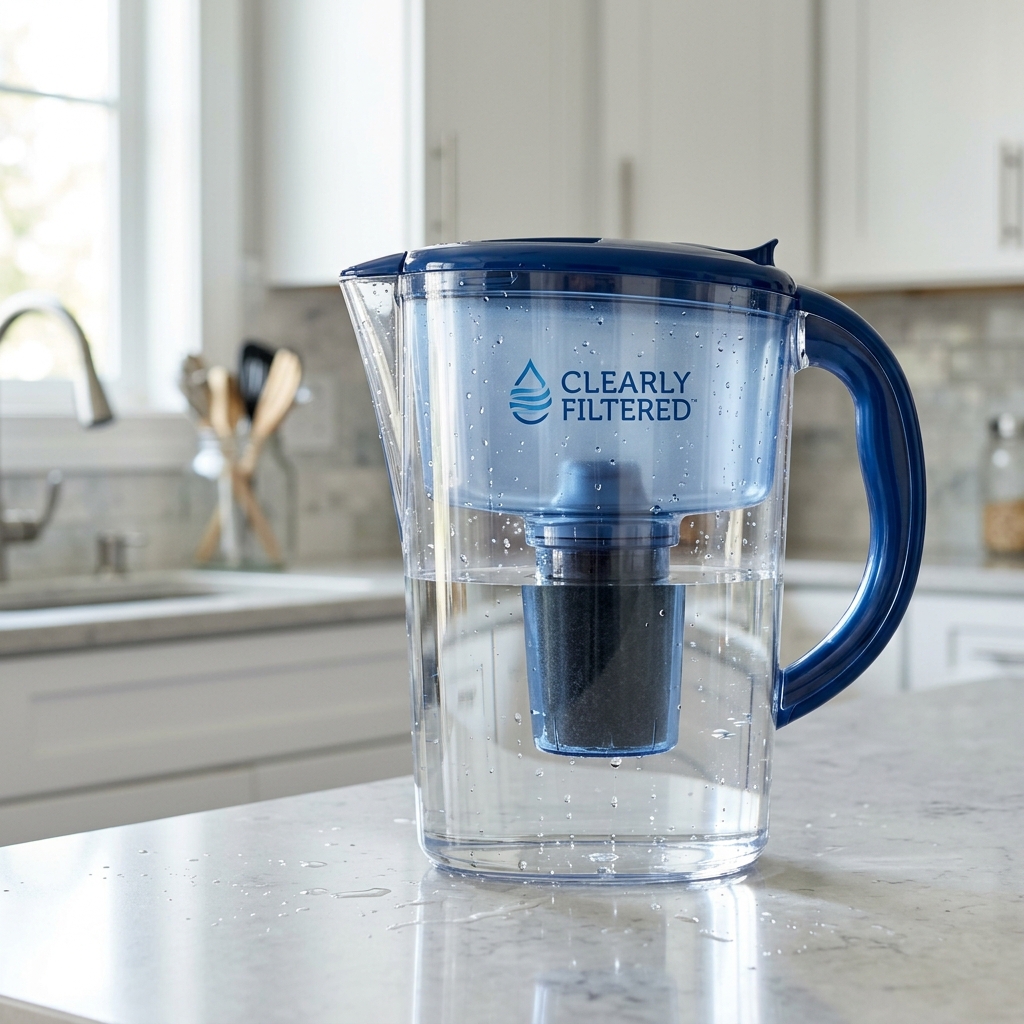
Clearly Filtered P-V3 with CF-PRF cartridge
Typically $90 to $120 for the pitcher and first filter
What the current record says The maker's November 2025 performance table reports more than 99.99% microplastics reduction after a challenge it labels 50,000,000 CFU/L and rates the CF-PRF cartridge for 100 gallons. The row does not identify the test particle material, shape, or size band.
What certification covers The current NSF listing names chlorine taste and odor under NSF/ANSI 42 plus lead-free materials under NSF/ANSI/CAN 372. It does not list a certified microplastics claim. NSF/ANSI/CAN 372 is about lead content in product materials, not removing lead or plastic from water.
Why there is no shopping button The result may be useful, but the missing particle-size detail blocks a fair comparison with Brita's defined band. Consider this pitcher when its broader laboratory report matches another tested water concern and you accept the difference between laboratory data and certification.
Fit and service The maker lists an 80-ounce lower pitcher, a 64-ounce fill reservoir, and dimensions of 11.4 by 5.25 by 10.87 inches. At one gallon daily, plan four cartridges from new per year. At two gallons daily, plan eight.
Clearly Filtered pitcher review and specificationsPlan a full year of cartridges
These examples use catalog planning ranges, not promised prices. They assume a new pitcher includes one correct cartridge and the household buys the rest. Tax, shipping, spilled water, and early clogging are outside the estimate.
| Use | Brita Elite | Clearly Filtered | Refill burden |
|---|---|---|---|
| 1 gallon daily | 4 filters from new; 3 replacements cost about $45 to $75 | 4 filters from new; 3 replacements cost about $150 to $210 | At least 2 full 10-cup volumes each day |
| 2 gallons daily | 7 filters from new; 6 replacements cost about $90 to $150 | 8 filters from new; 7 replacements cost about $350 to $490 | At least 4 full 10-cup volumes each day |
The cartridge counts round 365 or 730 gallons up to the next full 120-gallon Brita filter or 100-gallon Clearly Filtered cartridge. Replace sooner when the maker's time limit or water conditions call for it.
Products and shortcuts that do not solve this decision
The Brita Standard OB03 performance sheet lists chlorine, zinc, cadmium, copper, and mercury, but not microplastics or NSF/ANSI 401. A compatible pitcher body does not transfer the Elite cartridge's claim to Standard.
- A general NSF/ANSI 401 badge does not prove every optional claim under the standard. Find microplastics for the exact model.
- A pore-size claim is not a finished-system result. Media, sealing, flow, and cartridge age also matter.
- A TDS meter estimates dissolved ions from conductivity. It does not count plastic particles.
- A percentage without a size band cannot be ranked against a result for 0.5 to 1 micron particles.
Follow this three-step choice
- 1. Stop for unsafe or unknown water. Follow any advisory and test a private well. A pitcher claim does not replace disinfection or treatment for another measured hazard.
- 2. Choose Brita Elite for the defined pitcher claim. Confirm OB06 and a compatible system, then budget from actual gallons used.
- 3. Skip a pitcher when the routine will fail. Heavy cooking use, many bottles, or more than two gallons daily can justify an under-sink or countertop format with its own exact microplastics record.
Check six details before checkout
- Match the pitcher system and replacement cartridge to the performance sheet.
- Find a named microplastics claim and its tested particle-size band.
- Check every other measured water concern on that same model record.
- Divide daily filtered gallons by the rated capacity, then round up.
- Measure the refrigerator shelf and leave room to remove the lid.
- Stop the sale if the water is microbiologically unsafe or unknown.
For other formats, the microplastics filter buying guide compares pitcher, under-sink, and countertop choices. The water filter pitcher guide compares broader contaminant goals and cartridge costs.
Questions you may ask next
Do all pitcher filters remove microplastics?
No. Check the exact pitcher and replacement cartridge for a named microplastics claim. A general NSF badge, carbon media, or a small pore label does not prove the exact system has that claim.
Does the Brita Standard filter remove microplastics?
Brita Standard OB03 does not list microplastics in its current performance sheet. The named result belongs to the blue Brita Elite OB06 cartridge used in compatible systems.
Does Brita Elite remove nanoplastics?
Its current claim covers particles from 0.5 to 1 micron. That band overlaps one common description of nanoplastics, but it does not prove reduction of every smaller particle.
Is Clearly Filtered certified for microplastics?
Its current NSF listing covers chlorine taste and odor under NSF/ANSI 42 and lead-free materials under NSF/ANSI/CAN 372. The maker publishes separate microplastics laboratory data, but the public row does not state a particle-size band.
How often should I change a pitcher filter?
Use the earlier gallon or time limit. Brita Elite is rated for 120 gallons or about six months. Clearly Filtered recommends 100 gallons or six months. Heavy use or difficult source water can shorten service.
Can I use these pitchers on untreated well water?
No blanket recommendation applies. Both makers limit these pitcher systems to suitable treated water and warn against microbiologically unsafe or unknown water without adequate disinfection. Test a private well and follow local health guidance.
Still deciding? Start with your home and water.
The finder narrows the choices by water source, space, budget and the problem you want to fix.