Head-to-head buying guide
SpringWell CF vs iSpring WGB32B
Choose SpringWell CF, usually $1,100 to $2,200 before installation, when you have treated city water and want fewer routine media changes. Choose iSpring WGB32B, usually $400 to $600 before installation, when the lower entry cost and replaceable standard cartridges fit your budget and service plan.
Skip both for an untreated well, hard-water softening, bacteria, or a health contaminant that lacks an exact model claim. Main-line disinfectant removal also means the household must keep the system and downstream plumbing clean.
SpringWell fits
Fewer routine media changes and three flow sizes
iSpring fits
Lower purchase cost and standard 20-inch cartridges
Stop the sale
Wrong source, unsupported claim, or too little flow
Check the water before the equipment
Start with the utility's annual Consumer Confidence Report. It identifies the source, regulated detections, and violations. Ask the utility whether it uses free chlorine or chloramine now. A pool-like taste does not identify the disinfectant, and a sediment cartridge does not prove treatment for a dissolved contaminant.
Water source
Both base systems fit treated municipal water. A private well needs a laboratory panel and a different treatment plan.
Measured problem
Name free chlorine, chloramine, sediment, taste, odor, or another tested concern. Match it to exact model evidence.
Household demand
Add the flow of fixtures and appliances that may run together. Bathroom count is only a shortcut.
Installation limits
Check pressure, pipe size, grounding, supported wall or floor space, bypass access, and housing clearance.
Upkeep and budget
Plan for cartridges, shutoff time, water released during service, leak checks, and plumber labor.
Desired outcome
These are city-water filters. They do not soften hardness, lower TDS, or disinfect unsafe water.
How this comparison judged fit
The decision weighs exact model media, published flow, pressure range, replacement work, purchase and service budgets, installation, claim quality, and the condition that stops the sale. No numerical score is published because neither record provides a comparable finished-system test table for the same water and flow.
A peer-reviewed Journal AWWA study by Julian Fairey, Gerald Speitel Jr., and Lynn Katz tested five granular activated carbons. Chloramine reduction changed with carbon type, source water, and pH. The study did not test either retail system. It supports the need for exact test conditions instead of assuming that every carbon bed performs alike.
The NSF drinking-water directory lets buyers search exact models and reduction claims. Neither current product record supplies a finished-system certification number for the claims compared here. Component language or a generic standard reference does not certify the assembled system for a named reduction.
Affiliate disclosure: We may earn from qualifying purchases. Price ranges are planning budgets, not live offers.
The short comparison
| Decision point | SpringWell CF | iSpring WGB32B |
|---|---|---|
| Main format | Large catalytic-carbon and KDF media tank plus sediment cartridge | Three 20 by 4.5-inch housings with one sediment and two carbon blocks |
| Published flow | 9, 12, or 20 GPM on current sales page | 3 to 15 GPM operating range and 15 GPM peak |
| Pressure range | 25 to 80 psi | 25 to 80 psi |
| Routine service | Sediment cartridge every 6 to 9 months | All three cartridges up to 12 months or 100,000 gallons |
| Utilities | No treatment power or drain | No treatment power or drain |
| Planning price | $1,100 to $2,200 before installation | $400 to $600 before installation |
| Main evidence gap | No public exact-system endpoint table for broad claims | No public exact-system endpoint table for the base configuration |
SpringWell calls its numbers service flow. iSpring labels 15 GPM as peak and gives a 3 to 15 GPM operating range. Those labels are not equal. Ask what pressure remains after the filter at the household's sustained peak demand.
SpringWell fits lower routine service
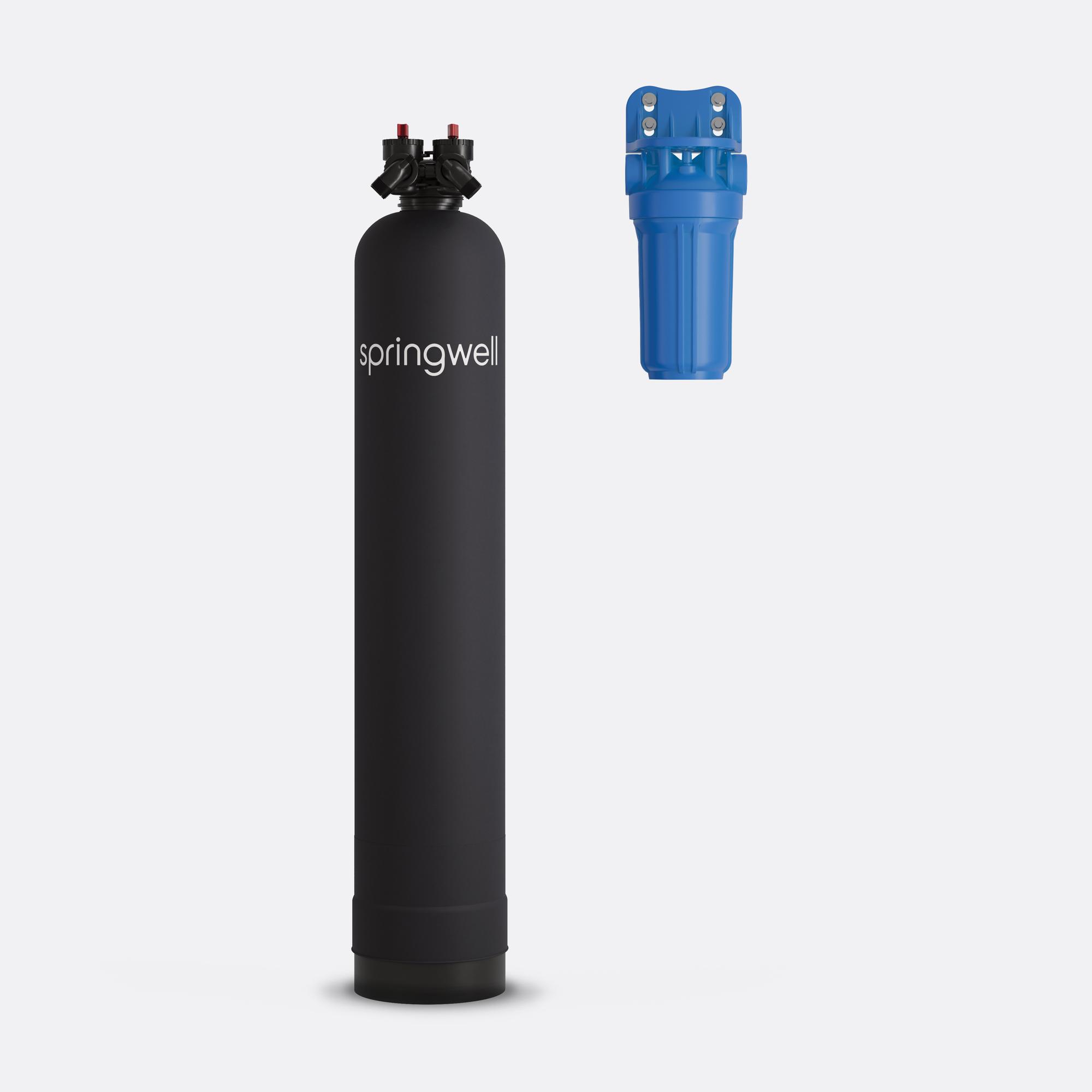
For fewer routine media changes
SpringWell CF Whole House Water Filter
$1,100 to $2,200 planning range before installation
- Models
- CF1, CF4, and CF+
- Current page flow
- 9, 12, or 20 GPM
- Main media
- Catalytic carbon and KDF
- Sediment stage
- 5-micron cartridge
Why it earns a narrow recommendation. The current SpringWell page lists three service-flow sizes, catalytic carbon, KDF, and a sediment stage. The large media tank shifts routine work to one sediment cartridge every 6 to 9 months.
Evidence limit. SpringWell names chlorine, chloramine, PFAS, and other chemicals, but the page does not publish an exact CF1, CF4, or CF+ challenge table with inlet level, flow, endpoint, and laboratory. Treat those as maker claims, not third-party finished-system certification.
Document conflict. The linked manual lists CF4 at 11 GPM and main-media service at six years or 1,000,000 gallons. The sales page lists 12 GPM and 10 years or 1,000,000 gallons. Get the applicable specification and service term in writing.
Sale-stopping flaw. Skip it when the decision needs an exact certified reduction, when the document conflict changes the size or ownership plan, or when the home cannot support the 48-hour media soak and full installation clearance.
iSpring fits a lower entry budget

For standard cartridges and lower entry cost
iSpring WGB32B
$400 to $600 planning range before installation
- Stage one
- FP25B 5-micron sediment
- Stages two and three
- FC25B carbon blocks
- Ports
- 1-inch female NPT
- Temperature
- 40 to 100 degrees Fahrenheit
Why it earns a narrow recommendation. The current WGB32B record identifies one sediment cartridge, two carbon blocks, one-inch ports, and a 25 to 80 psi pressure range. Standard 20 by 4.5-inch housings make the service parts easy to identify.
Evidence limit. iSpring advertises up to 99% chlorine reduction and around 100,000 gallons, but the exact system page does not provide the full challenge table needed to predict a result in a given home. The base WGB32B is not the lead, iron, PFAS, KDF, anti-scale, or chloramine variant.
Service burden. The WGB manual identifies FP25B followed by two FC25B cartridges. Three wet 20-inch housings need wall support, shutoffs, unions, a bypass, a spill plan, and enough room below to lower each sump.
Sale-stopping flaw. Skip it when yearly three-cartridge service is unrealistic, when peak flow needs a sustained 15 GPM result without pressure-loss data, or when the target claim comes from another blue-housing variant.
Ten-year cost depends on service choices
SpringWell starts about $700 to $1,600 higher before installation. Its sediment stage adds roughly $30 to $60 per year at the stated schedule. That puts equipment and routine sediment cartridges near $1,400 to $2,800 over ten years, before labor, parts, tax, leaks, testing, or main-media service.
The WGB32B needs one sediment cartridge and two carbon blocks per full change. The current iSpring replacement collection lists the exact FP25B and FC25B parts. Plan roughly $100 to $180 for a full set. One set per year puts equipment and cartridges near $1,400 to $2,400 over ten years before the same added costs.
Those bands can overlap. Heavy sediment or high disinfectant use may shorten iSpring service. SpringWell's six-year-versus-ten-year document conflict may add a main-media cost sooner than the sales page suggests. Ask both sellers for current part numbers, written service limits, and the cost of the next full service event.
Chloramine can stop both sales
SpringWell uses catalytic carbon and makes a chloramine claim. The base iSpring configuration uses two FC25B carbon blocks, while iSpring sells a separately named FC25B-NC chloramine cartridge. A replacement cartridge fitting the same housing does not transfer its result to the base system sold with different media.
If chloramine is the main reason to buy, request an exact finished-system report at the chosen flow. It should name inlet concentration, pH, temperature, contact time, endpoint, gallons processed, and laboratory. The chloramine buying guide explains why media type alone cannot settle the choice.
Installation differences change the workload
SpringWell needs floor and soak time
- Plan for a 52- or 58-inch installed tank height.
- Soak the carbon for 48 hours before final flushing.
- Match one-inch or 1.5-inch connections to the chosen size.
- Leave access to the sediment housing and bypass.
iSpring needs wall and sump clearance
- Support three filled Big Blue housings on a sound wall.
- Leave enough room below to remove 20-inch cartridges.
- Install shutoffs, unions, a bypass, and pressure gauges.
- Flush each new carbon set before household use.
Both systems need cold-water installation, protected indoor space, proper flow direction, plumbing-code compliance, and a grounding plan for metal pipe. Neither needs a treatment drain or operating power, but housing service releases water and needs a safe floor plan.
Who should skip both
- Untreated-well households. The well-water treatment guide starts with bacteria, nitrate, arsenic, iron, manganese, hardness, pH, and flow. City-water carbon cannot replace that work.
- Homes that need true soft water. The softener versus salt-free comparison separates hardness removal from scale control. Neither filter here does either job.
- One-tap health-contaminant buyers. A certified point-of-use filter can offer a stronger exact claim and far lower treated flow when drinking and cooking water are the only target.
- Households without a service owner. The CDC warns that whole-home removal of chlorine can allow more germs to grow in plumbing. Do not install a main filter that no one will maintain.
- Homes at the edge of a flow label. Add a pressure-loss test or choose more margin. A large peak number does not guarantee comfortable showers at the farthest fixture.
The no-commission step comes first
Read the utility report, confirm the disinfectant, measure static and peak-flow pressure, and get an installation quote before ordering. Use an accredited laboratory when a health contaminant drives the purchase. PureWater Filter Finder earns nothing from the utility, laboratory, pressure test, plumber, or finished-water check.
After installation, record inlet and outlet pressure plus the target water result. That baseline tells you when a cartridge is clogging or a reduction claim is no longer being met. Taste alone cannot prove safe finished water.
Questions buyers ask
Is SpringWell CF better than iSpring WGB32B?
SpringWell CF is the stronger fit when fewer routine cartridge changes matter and the higher purchase cost fits the budget. iSpring WGB32B is the stronger fit when lower entry cost, standard 20-inch cartridges, and visible service intervals matter more. Neither exact model has a public finished-system certification or endpoint table that proves every broad contaminant claim.
Does the iSpring WGB32B remove chloramine?
Do not transfer chloramine claims from another WGB32B variant or replacement cartridge to the base WGB32B. The base system uses one FP25B sediment cartridge and two FC25B carbon blocks. Its current exact-model record does not provide a finished-system chloramine result.
How often do the iSpring WGB32B filters need replacement?
iSpring lists up to 100,000 gallons or 12 months for the base sediment and carbon cartridges. Sediment load, chlorine use, pressure loss, taste, and measured finished-water results can shorten that interval. Replace all three with the exact compatible parts and flush them as directed.
How long does SpringWell CF media last?
The current product page says 1,000,000 gallons or 10 years. The linked manual says six years or 1,000,000 gallons. Ask SpringWell which written limit and warranty apply to the model and order before using a ten-year ownership estimate.
Will either system soften hard water?
No. Both leave calcium and magnesium hardness in the water. Choose an ion-exchange softener when lower hardness is the goal, or a scale conditioner when scale control without mineral removal is enough.
What should stop the purchase?
Stop if the source is an untreated well, the target is a health contaminant without exact model evidence, peak demand exceeds the chosen rating, pressure falls outside the manual range, or the installation lacks a bypass, support, grounding, and safe service clearance.