Sourced product review
SpringWell Well Filter and Salt Softener Combo Review
Choose the SpringWell WSSS combo only when a current well test shows both a WS-sized iron, manganese, or sulfur-odor problem and enough hardness to justify true softening.
Skip this $3,100 to $5,000 planning purchase when either treatment stage lacks a measured job. The bundle does not make unsafe well water safe, and it does not replace treatment for bacteria, nitrate, arsenic, or any other unproven target.
Buy when
Iron or sulfur treatment and true softening are both justified
Skip when
One stage has no measured job or another risk is untreated
Stop the sale
Pump, drain, flow, pH, space, or written specs do not fit
Start with the well test
The EPA tells private-well owners to test each year for total coliform bacteria, nitrate, total dissolved solids, and pH, then add local or symptom-led tests. Rust stains, black marks, rotten-egg odor, or scale point to questions. They do not identify the cause or treatment limit.
Use a state-certified laboratory. The CDC well-testing guide says the health department can help choose local analytes and interpret results. For this bundle, request iron concentration and form, manganese, hydrogen sulfide, hardness, pH, bacteria, and any locally important health contaminants.
Water source
This is a private-well treatment train. It is not the city-water CF and softener package.
Measured problem
Both the WS target and hardness load need numbers. One need does not justify both tanks.
Household demand
Add the flow of fixtures and appliances that may run together. Compare that peak with the lower stage rating.
Installation limits
Check pump delivery, pressure, drain capacity, air gap, outlets, floor space, pipe size, and service access.
Upkeep and budget
Plan for salt, two control heads, two regeneration schedules, water testing, service calls, and future media work.
Desired outcome
The WS stage treats named well-water problems. The SS stage removes hardness minerals. Neither proves broad purification.
How this review judged buyer fit
This review weighs treatment evidence, source-water fit, service flow, pump and drain needs, installation, upkeep, planning cost, and the condition that stops the sale. The assessment does not include hands-on or laboratory results from PureWater Filter Finder. It uses current manufacturer records, public health guidance, treatment research, and buyer math.
Penn State water specialist Bryan Swistock has worked on water-resource research and education for more than 30 years. His team explains that iron and manganese treatment depends on concentration and form. Their private-well treatment guide places filtration ahead of a softener when oxidized iron or manganese is present, because those solids can foul softener resin.
A peer-reviewed Applied Geochemistry study of aeration and rapid sand filtration found that regular backwash helped maintain flow while iron and manganese removal involved chemical and microbial processes. It did not test SpringWell or a home WSSS unit. It supports the need to treat backwash and water chemistry as core design limits.
The WQA certified-product directory explains that listed products pass standard testing and manufacturing audits. The current WSSS sales page and manual do not name a finished-system certifier or listing number. Ask for the exact WSSS1 or WSSS4 listing if independent certification is required.
No numerical buyer score is published. The product record lacks a full exact-system challenge report, certified capacity, regeneration-water figure, salt-efficiency figure, and resolved flow specification. Missing evidence is not a zero and cannot be averaged into a trustworthy score.
Affiliate disclosure: We may earn from qualifying purchases. Price ranges are planning budgets, not live offers.
What the WSSS bundle is
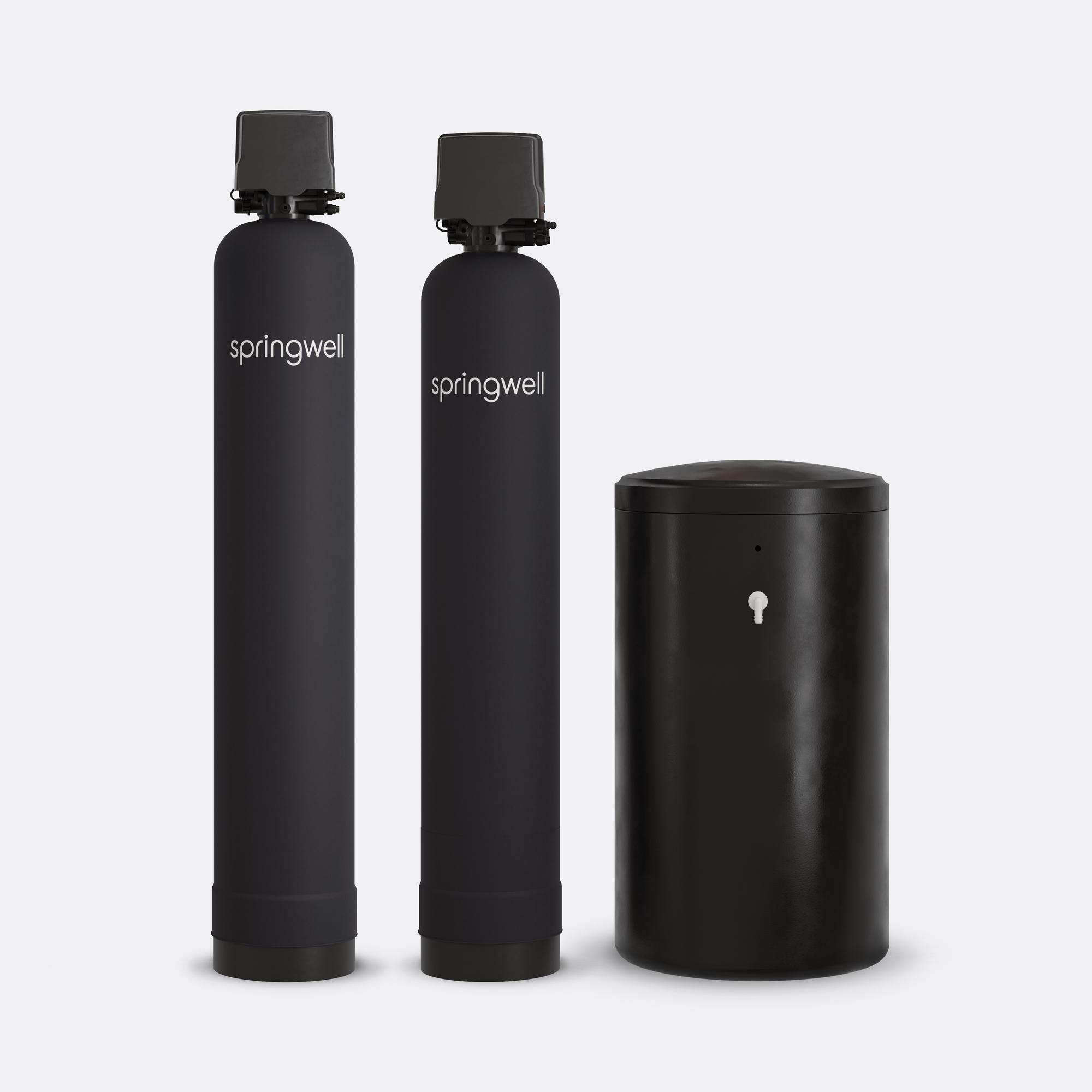
For tested iron or sulfur plus hardness
SpringWell WSSS1 and WSSS4
$3,100 to $5,000 planning range before installation
- Treatment order
- WS oxidation and filtration, then SS ion exchange
- Current choices
- WSSS1 and WSSS4
- Utilities
- Two outlets, treatment drains, and brine overflow
- Routine input
- Softener salt plus test-led service
Why it earns a conditional recommendation. The current WSSS page identifies separate well-filter and salt-softener stages and holds orders for water-test review. That sequence gives each tank one clear job.
Evidence limit. The page says the WS stage reduces iron, sulfur, and manganese and the SS stage removes hardness. It does not publish a full WSSS finished-water report with inlet values, outlet values, flow, gallons processed, laboratory, or endpoint. Treat the limits as maker ratings.
Sale-stopping flaw. The paperwork conflicts on WS4 service flow and softener connection size. A large purchase should not rest on guessing which figure ships. Get the exact tank pair, valve heads, connections, service flows, treatment limits, and warranty terms in writing.
WSSS1 and WSSS4 are two-stage systems
The bundle name can hide the main sizing rule. Water passes through two treatment tanks in series, so the lower stage rating sets the planning ceiling. A fast iron filter cannot push more useful service flow through a smaller softener without pressure loss or hardness leakage risk.
| Decision point | WSSS1 | WSSS4 |
|---|---|---|
| Paired stages | WS1 plus SS1 | WS4 plus SS4 |
| Lower published service flow | 11 GPM at SS1 | 13 GPM at SS4 |
| Softener capacity label | 32,000 grains | 48,000 grains |
| WS backwash supply | 5 GPM | 7 GPM |
| Softener backwash rate | 2 GPM | 2.4 GPM |
| Tallest tank with head | 64 inches | 64 inches |
| Brine tank | 18 inches wide by 33 inches high | 18 inches wide by 33 inches high |
Published service flow is not delivered fixture flow. Pipe size, pressure, elevation, treatment loading, and simultaneous demand all matter. Size from a measured demand plan and pressure test, not bathroom count alone.
The documents disagree on important details
The current linked WSSS installation manual shows the WS stage first and the softener second. It lists WS4 at 18 GPM, while the sales page lists 20 GPM. It lists 3/4-inch softener connections, while the sales page lists one-inch connections.
The conflict does not change the bundle bottleneck in the published table, because SS4 is listed at 13 GPM in both records. It can change the plumber's parts, the pressure-loss plan, and trust in the order details. Ask for a current submittal sheet tied to the actual WSSS model and valve heads before the return window starts.
The same manual says the filter and softener cannot regenerate together. It suggests separate start times and says water cannot be used during either cycle. A two-stage package needs two control schedules that remain staggered after an outage or clock reset.
Pump and drain limits can end the project
Service flow and backwash flow answer different questions. Service flow is the water sent toward the house. Backwash flow is the short, high drain flow needed to lift and clean the media bed. A well may serve normal fixtures yet fail to sustain the larger backwash rate at safe pressure.
The manual sets WS backwash at 5 GPM for WSSS1 and 7 GPM for WSSS4. Its ten-minute backwash setting implies 50 or 70 gallons during that step. The filter cycle also includes air draw and rinse, while the softener has its own two-hour regeneration cycle. Those figures are equipment planning inputs, not a prediction of the household's full monthly water use.
- Measure sustained well delivery at the treatment location, not only the pump's label.
- Confirm the pressure tank does not run dry or short-cycle during backwash.
- Size the drain, air gap, and discharge route for the higher WS rate under local rules.
- Keep both drain lines free of kinks and leave each valve head reachable.
The softener must earn its place
Hardness in grains per gallon multiplied by softened gallons per day gives daily grain load. A home at 15 grains per gallon and 200 softened gallons a day loads 3,000 grains each day. The 32,000-grain SS1 label would equal about 10.7 days before reserve and before adjusting for the actual salt dose. This is planning math, not a promised WSSS1 run length.
A hardness result near the household's acceptable range may not justify the softener, salt, drain water, and brine-tank work. In that case, the separate SpringWell WS well-filter specifications show the simpler treatment path. If hardness is the only measured issue, the SpringWell SS softener review avoids buying an unneeded oxidation tank.
The site's hard-water buying guide separates true softening from scale control. WSSS uses salt-regenerated ion exchange, so it removes calcium and magnesium hardness rather than leaving those minerals in the water.
Budget for the room around the tanks
The $3,100 to $5,000 equipment band is only a starting budget. Add a plumber quote, electrical access, drain and air-gap work, bypasses, pipe supports, local permits, startup testing, salt, and a service reserve. Difficult routing or an unsuitable drain can cost more than a simple equipment-room installation.
The system needs two media tanks plus the 18-inch-wide brine tank. The tallest listed tank is 64 inches with its head. Leave height to assemble and service the heads, room behind the tanks for bypasses and connectors, and a dry path for salt bags. Do not fit the three vessels by adding diameters alone.
Cost inputs to write down
- Exact WSSS model and delivered equipment price
- Plumbing, drain, electrical, permit, and startup labor
- Salt price and bags used under the chosen hardness setting
- Post-treatment testing and annual well testing
- Valve, media, resin, and service-call reserve
Free checks before checkout
- Health department guidance for the local well risks
- The current laboratory report, not a stain or odor guess
- A measured pump and pressure-tank delivery test
- A written plumbing and drain feasibility visit
- A post-install sample point before and after treatment
Who should buy and who should skip
Good fit
- A lab report shows both a supported WS target and meaningful hardness.
- The ordered pair covers measured peak demand at acceptable pressure.
- The well can sustain the listed WS backwash rate.
- The home has safe drains, power, floor space, and service clearance.
- The owner accepts salt handling and two control schedules.
Poor fit
- The purchase is based only on stains, odor, or a hard-water guess.
- Only the WS stage or only the softener has a measured job.
- Bacteria or another health concern lacks a treatment stage.
- The pump, drain, pressure, pH, or space falls outside the written plan.
- The household cannot keep salt, tests, and service on schedule.
Products that do not solve the same problem
A sediment cartridge can catch visible particles but does not replace a test-sized oxidation filter for dissolved iron or hydrogen sulfide. A softener alone can remove hardness and limited dissolved iron under suitable chemistry, but oxidized iron can foul the resin. A carbon whole-house filter is not an iron-and-hardness treatment train.
UV also is not a substitute for WSSS. It addresses a microbial goal after the water meets the UV unit's inlet limits. The bacteria treatment guide explains why pretreatment and dose conditions matter. A positive bacteria result should trigger health-department or qualified professional guidance before an equipment bundle is chosen.
Verify the result after installation
Sample raw water and treated water from planned ports. Check the targets that justified each stage, including iron, manganese, odor-related chemistry when measurable, and hardness. Recheck after startup and on a schedule set by the lab, local guidance, and the source-water pattern.
A clear glass and softer feel cannot establish safe water. Keep the annual well panel, watch pressure during household peaks, log salt additions, and record regeneration changes. A result outside the promised range belongs in a service call while the written test, order, and installation records are easy to find.
Frequently asked questions
Is the SpringWell WSSS combo worth it?
It can be worth it when a current laboratory test shows both a WS-sized iron, manganese, or hydrogen sulfide problem and enough hardness to justify true softening. Buy neither stage until the water chemistry, pump supply, drain, peak demand, and installation space all fit.
What is included in the SpringWell WSSS combo?
The WSSS package pairs a WS air-injection well-water filter with an SS metered ion-exchange softener and a brine tank. The current selector offers WSSS1 and WSSS4. It is a treatment train, not one tank that does both jobs.
Does SpringWell WSSS remove bacteria?
No microbial treatment is established for the WSSS bundle. SpringWell warns not to use the WS stage on microbiologically unsafe water. A positive bacteria result needs an approved response and may require disinfection after suitable pretreatment.
How much flow can WSSS1 and WSSS4 provide?
The lower published stage rating is 11 GPM for WSSS1 and 13 GPM for WSSS4. Those are service-flow labels, not a promise of pressure at every fixture. The current page and manual also disagree on the WS4 rating, so measure peak demand and get the ordered configuration in writing.
How much drain flow does the SpringWell WSSS need?
The combo manual lists WS backwash rates of 5 GPM for WS1 and 7 GPM for WS4. It lists 2 GPM for SS1 and 2.4 GPM for SS4. The well pump, pressure tank, drain, air gap, and local plumbing plan must support the chosen pair.
What should stop a SpringWell WSSS purchase?
Stop if the test does not show both treatment needs, bacteria or another untreated health concern is present, pH falls outside the written range, the well cannot sustain backwash, the drain is unsuitable, peak demand exceeds the lower stage rating, or the seller will not resolve document conflicts in writing.